Ideas from our Agile Testing Days workshop participants, shared by co-facilitators Jen Cook and Lisa Crispin
Jen Cook and Lisa Crispin co-facilitated a workshop at Agile Testing Days 2025 called “Testers, Don’t Panic! Your Future in Quality Engineering”. Participants worked in groups of four to brainstorm their ideas about how testing professionals can grow into Quality Engineer (QE) roles and help lead quality transformations in their organizations. An amazing wealth of ideas emerged in 105 minutes! Our goal is to share these with the wider software community, and we will summarize the outcomes here.
Skills for Quality Engineers
In the first exercise, the groups used an adaptation of a “brainwriting” technique to brainstorm the skills that needed to grow into a QE role. This included how they see the QE role differ from other testing roles, and skills that help a QE bring value to their teams.
Each group came up with many dozens of ideas! Of course, many were the more obvious, known must-haves for any testing professional, including QEs. Before you aim to grow your QE skills, make sure you have the foundational skills such as exploratory testing, critical thinking, test automation, risk assessment, and a high-level understanding of more specialized areas such as security and accessibility. Of course, curiosity is a pre-requisite for any tester.
Here, we want to highlight the ideas that seemed the most interesting and less obvious, especially to those not yet familiar with the capabilities that QEs bring to their organizations.
Leading quality and continuous improvement
Quality Engineers are strategic contributors who lead their teams to improve product and process quality. Many of the skills listed by the participant groups fall into the leadership category. Here’s a summary of leadership skills listed by our groups:
- Empower the team to build better software
- Foster a quality culture, encourage whole-team ownership of quality, helping team and stakeholders understand the value of setting and meeting quality goals
- Promote continuous improvement and learning
- Ability to explain time needed for various activities that improve quality to stakeholders, programmers, managers
- Shield the team from pressure to achieve impossible goals such as unreasonable deadlines or competing priorities.
- Help teams and individuals manage their workloads for a sustainable pace
- Empathy – ability to see problems from different perspectives, eg. customer, product, operations
- Ability to unlearn behavior that’s no longer helpful
- Helping ensure transparency through reporting and other means
- Willing to switch roles when needed, “wear a lot of hats”
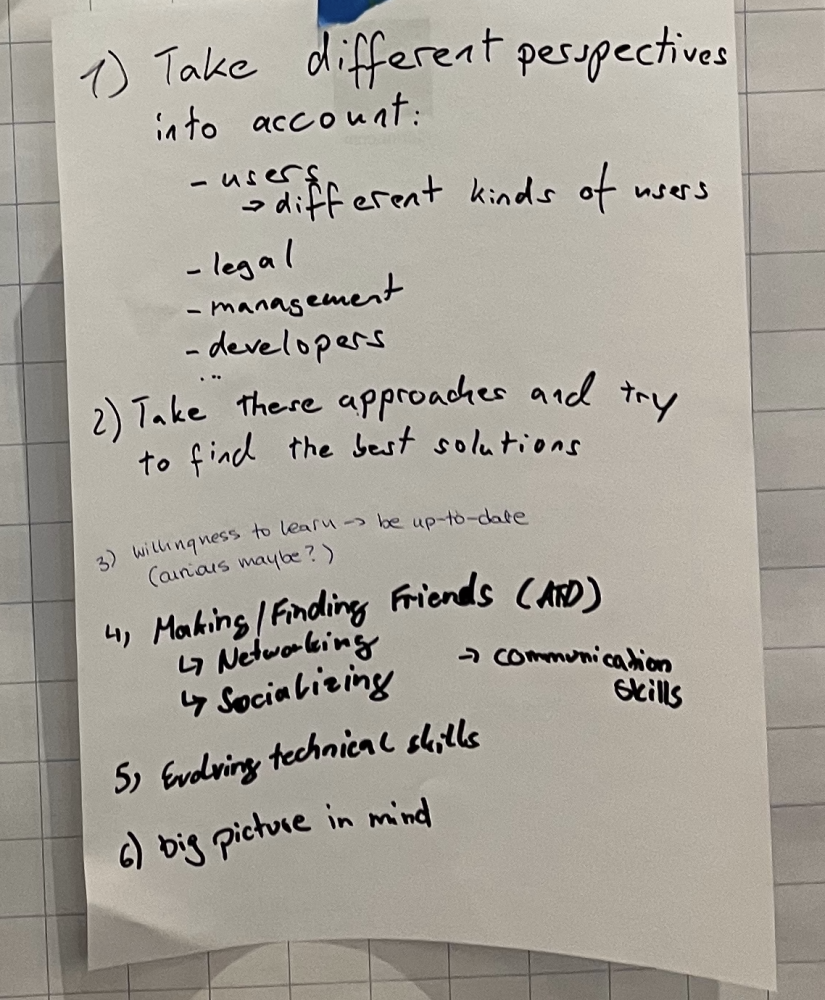
To effect change, participants agreed that QEs need to know how to help the team design experiments, forming and testing hypotheses, and measuring progress to know if the experiments are moving them towards their goals. Along with this, QEs need to “just do stuff and try things”.
There was also consensus that QEs need facilitation, teaching and coaching skills to educate people about quality and testing.
Each group also came up with specific skills that feed into those capabilities, so let’s look at those.
“Next-level” communication
QEs lead teams to continually improve, and communication is a major part of being able to influence change. Each group’s ideas list suggested ways QEs take communication to the next level, not only within their team, but throughout their organizations. Here are some to consider for your own QE journey.
Communication across roles and organizations
QEs need the ability to facilitate communication among other roles – within their delivery team, and with other parts of the organization. For example, connecting the product people with delivery team members to establish shared understanding of how a new feature should behave. QEs can facilitate structured conversations amongst all stakeholders and contributors. They elicit concrete examples to quickly get everyone on the same page.
Building and documenting a common language
QEs know how to help the team agree on a common, domain-specific language. They make sure that terminology is well-documented in a place accessible to all.
Question-asking
Quality engineers amp up their question-asking skills. They have the courage to ask uncomfortable questions. They know how to

gather information from people in different roles on their delivery team, and from people in other parts of the organization. They build strong relationships with a wide network, and build trust, so that they can engage others in effective and sometimes difficult conversations.
QEs know how to ask open-ended questions, to encourage thinking outside the box. They question the current solutions, to spark discussions about whether a new approach should be tried. A vital skill is questioning outcomes, such as those automated tests that never fail. QEs aren’t afraid to ask for help, and with the diverse relationships across the organization, there are many places they can go for help.
Asking questions isn’t valuable without good listening skills. This was a good reminder to Lisa, who has always has to work on her listening skills!
Giving and receiving feedback
Feedback is part of any testing professional’s job. QEs are often faced with the really uncomfortable situations, where they need to deliver information that the recipient won’t welcome. Conversely, as a QE, you need to receive difficult feedback and use it productively.
Fostering collaboration
QEs work to get the whole team engaged in building quality in throughout the development cycle. QEs spot friction, and look for ways to work through it. For example, a QE can bring the team together to talk about expectations for each role on the team.
Building relationships
Those good communication skills help QEs have the flexibility to collaborate with people from a wide diversity of backgrounds, experience, and personality. Networking is an essential superpower. Building trust allows for those difficult conversations to deliver positive outcomes.
Balancing business and user needs
QEs build a deep understanding of what both business stakeholders and customers need from the product. They can speak the business language. QEs find ways to get quick feedback from users, either directly or via telemetry. They know how to balance user experience with feasibility from the business perspective.
Negotiation skills are also a handy part of a QE’s toolbox, to help find trade-offs and achieve that balance.
Keeping focus
Workshop participants listed a lot of skills related to helping teams identify, prioritize and mitigate risks. And along with that, focus on value to customers, the business, and the team. They talked about a good mindset for QEs, which includes healthy skepticism and being able to keep things real.
The QE can design collaborative sessions to brainstorm about risks and prioritize the top quality attributes to build in. Part of this is the ability to measure value and risk, and whether the team is meeting their goals in solving customer problems and minimizing customer pain.
More than one group also mentioned that QEs need to keep the big picture in mind. What does quality look like to the customer, as they use the whole product? Focusing on the most important risks and quality attributes is key.
Thinking skills
It’s hard to confine any of these skills to one section of this blog post. The workshop groups talked a lot about a wide range of thinking skills. Design thinking, critical thinking, strategic thinking, QEs use all of these. Lateral thinking, aka thinking “outside the box”, is vital, along with logical thinking. QEs also help the team practice these diverse ways of thinking.
Problem-solving skills, adaptability, and recognizing patterns and anomalies were also highlighted in the skills lists.
Technical awareness
We’ve seen a lot of debate on whether testers on modern software teams need coding skills. Our participants recommended these technical-oriented skills for QEs:
- Understanding the system under test, high level architecture, infrastructure
- Tools, including version control, deployment pipelines, test automation frameworks
- Pseudo coding – One group said “coding knowledge”, this is definitely helpful but not everyone agrees it is required. Knowing enough to collaborate with coders is key.
- Other skills from other roles such as system / process mapping (business analysis)
Where/how to get the skills?

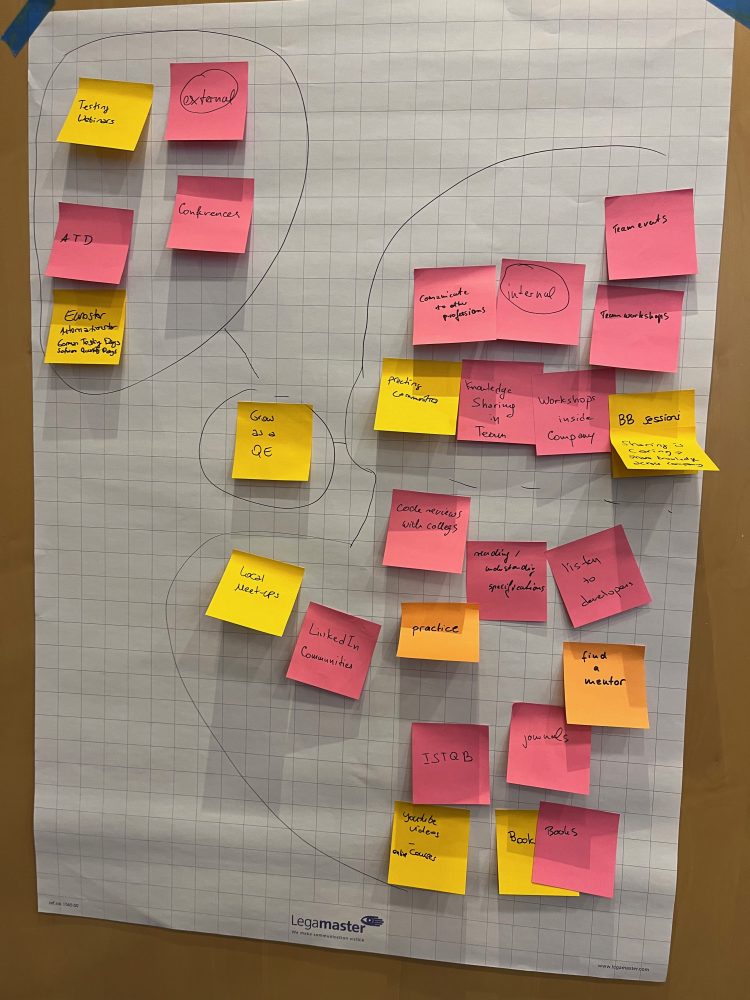
For the second exercise, table groups used mind mapping to brainstorm on how people can learn the skills needed to grow into a QE role. Where might people learn these skills? What resources are available – books, online content, training?
This exercise produced the tried-and-true ways most of us learn. Conferences, meetups, live and on-demand training courses, online communities, books, podcast and the like.
Participants also suggested learning from others at work. Get a mentor, learn from colleagues in other roles, communities of practice. Have a test party / ensemble testing session, get non-testers involved to benefit from new perspectives. Team-building activities like solving puzzles together is one fun idea. Code reviews together with other team members is often a good way to learn. Of course, GenAI is a resource lots of people are using these days.
Learning from failed experiments and mistakes is always valuable! Another good suggestion – just try things!
Inspire a transformation in your organization
For our final brainstorming session, the whole class brainstormed together to call out ideas to lead your organization to embrace quality engineering. Here are the suggestions:
- Establish quick feedback loops
- Promote visibility, transparency
- Show business folks what you do
- Lead by example
- Find value in influencing change
- Facilitate risk assessment workshops, such as Risk Storming
- Facilitate Holistic Testing workshops
- Find the courage to do a “transparent” testing session, like the one Elizabeth Zagroba and James Lyndsay did in their ATD keynote
- Focus on the end goal, the big picture
- Avoid or automate quality gates
- Practice Value Stream Management (see the 2025 DORA research on this)
In general, these ideas are congruent with what’s already been published and discussed about quality engineering in our communities and conferences. It’s reassuring that a group that included people who weren’t at all certain how to navigate the road to being a quality engineer see similar value to what established QEs do.
We feel that the role of Quality Engineer gives quality and testing professionals a vital leadership role in software organizations. It gives more visibility to what we contribute, and puts us on a more equal footing with other roles. Definitely a career path that is worth your consideration. We hope the ideas from our participants help inspire and guide you on your journey.