The first day of Agile Coach Camp began with each person introducing him- or herself and his-or-her superpower. There were some clever ones. I said mine was getting people to write on the whiteboard, because whenever I do, magic happens, but then Tim Ottinger tweeted his disappointment that my superpower didn’t involve donkeys.
The first open space session I attended was on Systems Thinking, facilitated by Ken Furlong. I didn’t understand a lot of this, and there were some skeery formulas, but some folks tweeted some links to me to learn more about it.
Net-Maps
Net mapping is my biggest takeaway from ACCUS so far. Eva Schiffer, whose background is in things like working with GMOs in Ghana and not IT, created net mapping to identify different people or organizations that influence a project. You identify the players: people, departments, groups. You draw connections with color-coding between them, for example, hierarchies, funding, conflicts, adversaries, being in it together. People can do the maps together.
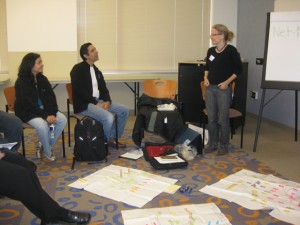
- Eva Schiffer explains net-maps

Stacks of checker-like objects piled on each influencer denote the amount of influence. This is a great visual. If you’re doing this with a group, rather than denote “positive” and “negative” influences, you could choose two more neutral goals, such as “stability” and “change”, so that people feel safe. Eva noted that the “average view” of who influences what doesn’t do anything for you, you have to let each person explain their viewpoint.
I’m such a fan of mind mapping, and this seems to take it to another level. I am eager to try this.
One of the participants, who is from the education profession (not IT), suggested it would work well for kids, for things like exploring peer pressure. It was so interesting to get perspectives from people outside of IT, both leading and participating in ACCUS sessions.
More than Agile
George Dinwiddie facilitated this session on what agile coaches need to know besides agile. Many skills we talked about were what Isabel Evans calls “thinking skills”, other people call them “soft skills”: facilitation, creating space for the development team, PR, team dynamics, teaching people outside the team to support the team rather than trying to “drive”. We talked about ways to help teams learn to self-0rganize: providing gentle direction, helping form the team, helping them take on achievable challenges. One tweetable quote from this session was “Trust goes in, pride goes out”.
I was lucky that our team had Mike Cohn for our manager/coach for the first year of our agile transition. First he helped us decide on our commitment to quality. We committed to delivering the best quality software that we possibly could. Mike helped us make this commitment mean something. He exhorted us every day to write code that we’d be proud to take home and show our moms. He told us over and over, “I don’t care how much you get done, or whether you meet some deadline. I only care that you produce the best quality that you can.” It took a long time for the team to trust this message, but once we did, we invested a lot of time to learning valuable practices such as test-driven development and specification by example. This investment paid off in the ensuing years, as we built up a good base of re-usable code and test code. We have always kept our technical debt at a manageable level, and as a result we have a good steady velocity.
QWAN: Providing basic agile knowledge online, for free

- QWAN Why, What, How
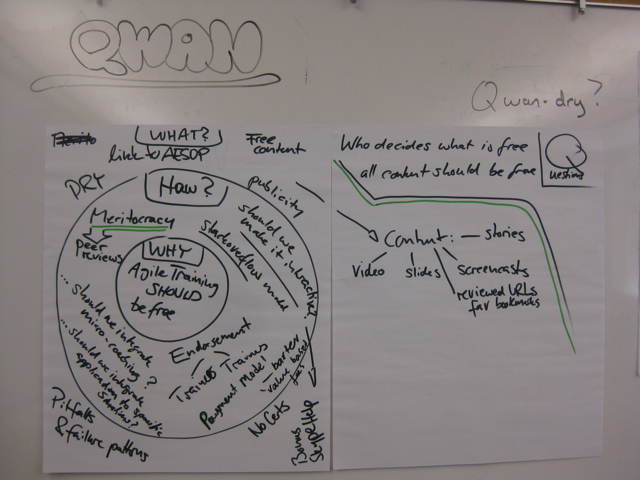
Olaf Lewitz explained the idea of a free interactive course to teach agile basics, called QWAN (Quality Without a Name). This effort was partly inspired by the Kahn Academy. We brainstormed the what, how and why of this community effort, and came up with both ideas and questions. Check out the photo.
7 comments on “ACCUS Day 1”
Hi Lisa,
Great that you liked my Net-Map session, it was amazing to see how open people at ACCUS were to listen to people from other fields and try out new stuff. If you do use the method in your work, I would be curious to hear how it worked for you.
Cheers and all the best
Eva
Excellent, hadn’t heard of net maps before, I need to go learn more about them. Thanks Lisa for sharing.
Lisa,
Thanks for taking the time to share. For those of us that couldn’t make it to the event it’s great to get some first hand experience and links/information to follow along.
—
Derek
[…] un post de Lisa Crispin he leído algo que me ha hecho recapacitar sobre el modo en que programo. He […]
Were there any Systems thinking books recommended ? I am getting swayed more and more by books like ‘The Goal’ and theory of constraints and Systems thinking as the old system is not working.
There are lists on the net but I am trying to buy a good one.
I had one more question about technical test cases for NFR. In many large-scale projects we have a requirement for technical test cases. (e.g) Windows Folder access requires domain controller login,, socket timeout verification, encryption/decryption etc. There are so many functional test tools like cucumber, FIT tables etc.
Are there any diagramming techniques or testing ideas for these types of test cases for NFR also ?
Mohan, I haven’t read it yet, but Gerald Weinberg’s book _An Introduction to General Systems Thinking_ is bound to be a good reference. Also, Peter Senge’s book _The Fifth Discipline_ has been referenced as the book that popularized systems thinking.
For non-functional or extra-functional testing, there are lots of load and performance test tools, we use JMeter here. I don’t know of specific security test tools, but you could probably do some security testing with both GUI and API-level tools. That would be a good question for the agile-testing Yahoo group.